The legacy of Thandi is one of uncommon resilience, and we were fortunate to see her.
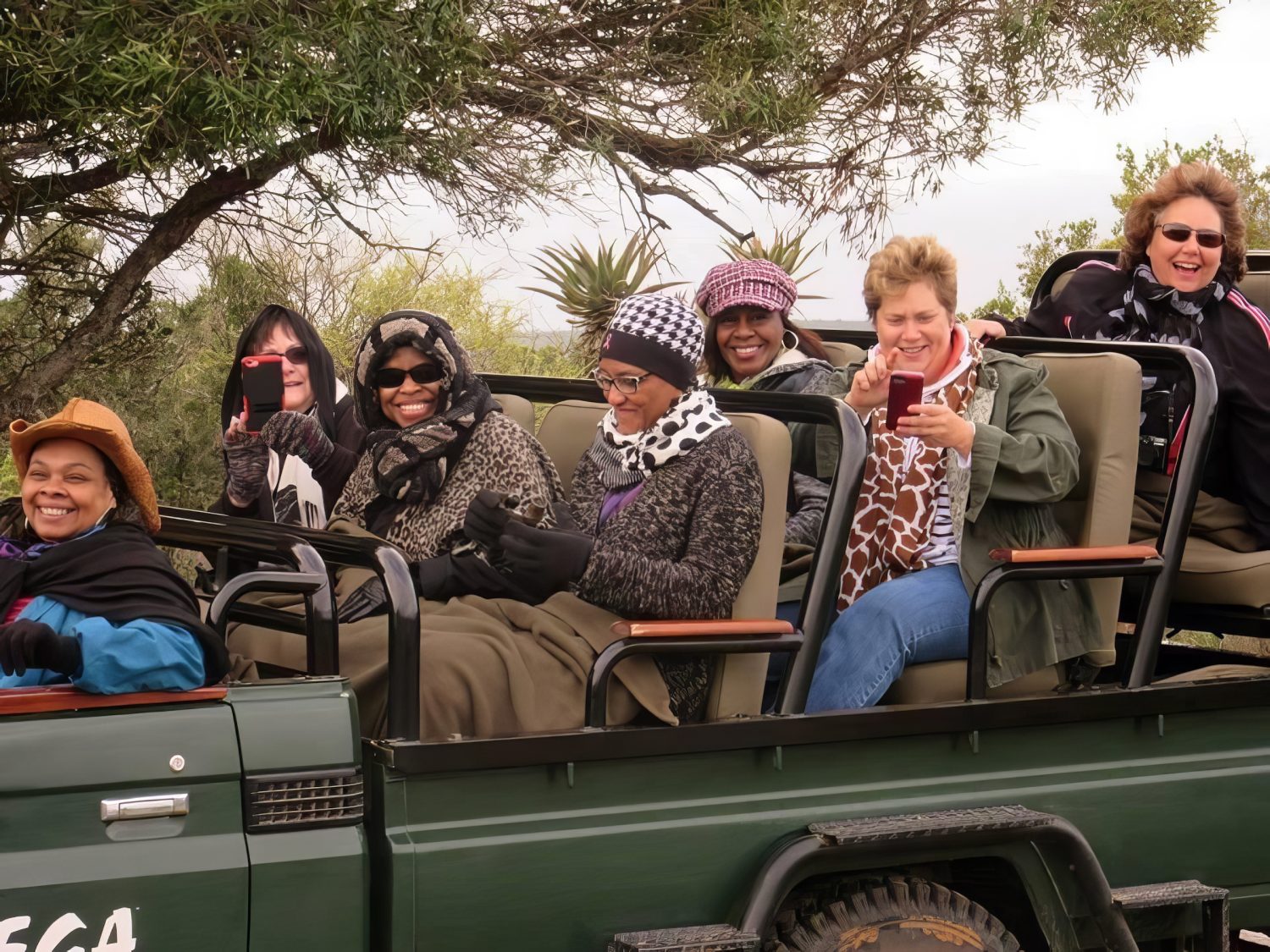
There was just enough light in the grey dusk to see a large shadow cross the path. She was just a few yards ahead of our open-air truck as we crossed open terrain, headed back to our lodging. We were in the Eastern Cape of South Africa at Kariega Game Reserve. By the outline of the shadow, Jo, our seasoned guide, knew that it was Thandi because her belly protruded with a baby on the way. Jo stopped the truck, turned off the engine, and flashed a small light above the animal to give us a glimpse. We made no sound. We all sat there stunned and barely breathing. My skin tingled, and the hair on my arms stood up. There was Thandi, a female white rhinoceros that poachers had viciously attacked, and she was living in the wild.
Thandi was in her element, going about her own mysterious business. We did not distract her from her mission. She never changed her steady gait and merged much too quickly into the increasingly black abyss of night. We strained our eyes to see more of her, but she was gone from our view in less than a minute.
Thandi is a survivor of poaching, rare, and that’s why the legacy of Thandi is important, to offer hope for the future of rhinos.
In fact, she is the poster child of that brutal act, and there are numerous videos of her story. Poachers were successful in getting her horns, but she survived. I saw her in 2014. Celebrities such as Chinese basketball player Yao Ming and English business magnate Richard Branson are WildAid ambassadors for sharks, elephants, and rhinos, and have documentaries that include Thandi. The goal of the ambassadors is to educate and discourage people from buying products made from rhino and other horns.
Seeing wildlife is a chance encounter on these excursions in South Africa. Wildlife lives in its own environments, and its movement is not completely predictable. My group of four was fortunate to have had two encounters with Thandi, close enough to thrill at her enormous power and remember her for a lifetime.

The legacy of Thandi is a compelling story. As we prepared for our drive the next morning, we unanimously said that we wanted to try to see Thandi again.
At the last minute, a fifth passenger joined us, a wildlife caretaker who shared firsthand details of Thandi’s story. We rode for a while, then parked the truck and waited. It was not long before Thandi walked right past our truck from behind and parallel to the left of us, about 20 yards away. A female white rhino can weigh up to 5,000 pounds. Words cannot describe the experience of seeing a rhino that close. And to see Thandi after hearing her story was very special. We also learned that Thandi was pregnant when poachers attacked her. It’s a miracle that she will give birth, considering what she had endured.
That Thandi was alive and able to bear the calf after so much suffering is a miracle. The leagacy of Thandi will live on.
Poachers attacked Thandi and two other rhinos in 2012. Security patrols found Thandi and one other rhino, Thandi’s mate, Themba, alive. Doctors went into the bush to treat them every few days. Sadly, Themba later drowned, too weak to get out of a watering hole. Doctors discovered that Thandi was pregnant, which made her story of resilience even more compelling.
The footage at the discovery site is heartbreaking and unbearable. But the videos of Thandi and her calf are heartwarming and full of hope. The calf, named Thembi (meaning Hope in isiXhosa), is also famous. Wildlife filmmaker Adrian Stern aptly dubbed her story: “the rhino that should never have been born.” Thandi had another calf, named Colin, born in Jan 2017, and she continues the business of raising her family while also raising hope for the future of white rhinos in South Africa.
Thandi’s story stands out as a poignant notice of how wildlife in Africa struggles to survive. There is a literal war between the poachers and the protectors. Not only rhinos but also elephants, giraffes, hippos, and other wildlife are at risk due to poaching and loss of habitat. I feel humbled and blessed to have seen Thandi, the resilient rhino, and other incredible wildlife during our visit.
View the celebration video of Thandi with her recently born sixth calf, along with other wildlife stories at Kariega Game Reserve.
Put “Thandi” in the search bar and watch the video with Yao Ming – WildAid.
In addition to Thandi, our guide showed us other animals we wanted to see.


The giraffe at the sweet thorn tree greeted me face to face every morning from my elevated back deck.
Travel Note
Leadership Women curated this international travel-study trip. A nonprofit headquartered in Dallas, Texas, Leadership Women is the longest-running organization specific to women. It self-proclaims to “advance and improve the personal, economic, and professional status of women”.
Wildlife Watch is a valuable resource for following poaching issues. It is an investigative reporting project between the National Geographic Society and National Geographic Partners focusing on wildlife crime and exploitation.
Over 1,000 rhinos were poached there in 2017. They are considered in “imminent danger” of becoming extinct. Eighty percent of the world’s remaining rhinos are in South Africa.
The world’s last male northern white rhino, Sudan, died in 2018, the year I wrote this story. Two females, Sudan’s daughter and granddaughter, remain at the Ol Pejeta Conservancy in Kenya under armed guard. Scientists are using extraordinary means to attempt to save the species. See the latest CNN report.
You must be logged in to post a comment.