Discovering the magic of Mexico, we embarked on an inland journey that included two distinct cities, both dreamy and romantic but very different. Mexico City pulses with vibrant energy and boasts a diverse cultural scene—ballet, art, and gourmet cuisine. Its bustling streets, museums of ancient civilizations, exquisite art, and sculptures almost shout out loud its rich and romantic heritage. Conversely, Santiago de Querétaro, or simply Querétaro, is just 131. 5 miles northwest and has no need to flaunt its romanticism. Its pedestrian-friendly plazas, immaculate Spanish colonial architecture, and 18th-century stone aqueduct speak of romance at every turn. The contrasting cities offer visitors different experiences. The ancient Teotihuacan Pyramid is the perfect place to cleanse the palate in between.


Folkloric Ballet – Discovering the Magic of Mexico City
Palace of Fine Arts is home to Ballet Folklórico de México, which has toured the world for over 60 years. The dance offers a captivating glimpse into Mexican culture and is the best first stop to begin the magic. It narrates Mexico’s history from pre-Hispanic times to the Mexican Revolution in a blend of ballet, traditional, and contemporary Mexican dance. The spectacular costumes and innovative choreography animate legends, stories, and history. Yaqui rituals inspire the most popular segment, the Hunt. The dancer’s precision in executing the image of fallen prey is slow and exacting. The imitative movements were so powerful that we, the audience, breathed an audible sigh when the dancer finally lay still.
Basilica of Our Lady of Guadalupe
The Modern Basilica of Our Lady of Guadalupe in Mexico City is part of a large complex that includes the Old Basilica and the Plaza of the Americas. The complex attracts a staggering 20 million pilgrims and visitors annually. The high number of visitors necessitates a conveyor-belt system to move thousands of visitors each day past the Tilma of Juan Diego. During ceremonies, 10,000 people fit inside, with half standing. Another 50,000 people are outside. I tried to visualize the people coming, some crawling on their knees across the stone plaza. The physical sacrifice called manda is a solemn vow or promise, either to ask the Virgin Mary for a miracle or to thank her for answering a prayer.
The Story of the Tilma of Juan Diego
On December 9, 1531, the Virgin Mary appeared to Juan Diego. Her image was imprinted on his cloak, which is now housed in the Basilica of Santa Maria de Guadalupe in Mexico City. The Basilica Chapel of Our Lady of Guadalupe, however, also depicts the image, surrounded by those of people from North, Central, and South America. Curved walls make visitors feel as if they are encountering an apparition, especially striking up close from the conveyor belt.


Frida Kahlo Museum
The Frida Kahlo Museum, known as La Casa Azul (Blue House), is where Mexican artist Frida Kahlo (1907-1954) was born. She spent her childhood there, much of the time bedridden from polio. The house features striking blue hues throughout the rooms, corridors, patios, and an inner courtyard. It’s the perfect setting for telling the artist’s life story and showcasing her work, with vivid colors and magical themes that are as much a part of Mexican culture as they are of the artist’s life.
With triumph over devastating disease, injury, and pain, Kahlo gained international fame and became an icon of feminism and freedom of choice. Blue House is appropriately located in the Coyoacán neighborhood, which the Secretary of Tourism officially designated as a Barrio Mágico (Magic Neighborhood).
The museum, or Blue House, like her art, is a reflection of Kahlo, her unique style and her determination to express herself in art.


National Museum of Anthropology & Chapultepec Forest
Over 2 million visitors a year enter Mexico City’s National Museum of Anthropology. Home to significant artifacts from Mexico’s pre-Columbian period, the museum is a haven for scholars, history buffs, and tourists. One popular piece is the famous Aztec Stone of the Sun, the Aztec calendar stone, which measures a jaw-dropping 11.75 feet in diameter and 3.22 feet thick.
Just outside the Museum is another area, uniquely Mexican. We entered Chapultepec Park, one of the largest urban forest parks in the Western Hemisphere. At the gates, we sampled street food and watched the Moko Jumbies (stilt walkers). Some dressed as skeletons to celebrate the Day of the Dead. We caught glimpses of the Danza de los Voladores (Dance of the Flyers), a magical feat. The ancient Mesoamerican ceremony, re-enacted, included four or five participants. Dressed in colorful costumes, one performer, tied by a rope, launched into the air from a 90-foot pole. The other played flute and drum from atop the pole. In ancient times, performers might have been asking the Gods for an end to severe drought.
Discovering the magic of Mexico sometimes requires a person to be brave, such as sampling fried grasshoppers from the bicycle peddlers. Truly, Mexico City offers a tantalizing range of food, everything from street food to top-tier restaurants. Gary Sheyingart sums it up.
“Just below New York in its ability to synchronize indigenous with global cuisines with such panache.” – Gary Shieyngart, Travel + Leisure Magazine
Dinner at Villa Maria, in Mexico City, was one of my favorites. The atmosphere in the two-story building was colorful and lively, with live musicians. Menu items included mild chili-stuffed crab, beef medallions in tequila sauce, and huachinango (red snapper) steamed in banana leaf. And the margaritas were superb!
Teotihuacan Pyramid – Discovering the Magic of Mexico
After a detour from Mexico City to Querétaro, we arrived in Teotihuacan and took 248 steps to the summit of the Pyramid of the Sun. Hawkers called out to us at the entry to the Pyramid. Mexico is the world’s leading producer of silver, which makes it inexpensive compared to other places. Vowing to shop on the way out, we continued to the pyramid’s steps. Climbing to the summit, we enjoyed sweeping views of the valley below. In Mesoamerican times, in the 1st millennium AD, the pyramid overlooked a thriving city of 125,000 people.
True to our word, we stopped and purchased jewelry on the way out. Beware, my wise friend, Elevene implored: some sell a cheap alloy of copper, nickel, and zinc. Look for the .925 stamp, but counterfeiters can fake that as well. If you have a heavy piece that the seller marks down significantly, it may be fake. Use the walk-away method: “no gracias,” then walk away. Sometimes the vendor offers a lower price. Vendors expect to bargain, so the rule of thumb is to use a 50% drop as a starting point, and always do so in a courteous manner.
My friend, Elevene, helped me bargain for silver but half-jokingly cautioned that I was not yet ready for gold.


Discovering the magic of Mexico from the summit of the pyramid, we then descended into the earth’s depths. La Gruta Restaurant is one of the most fascinating and iconic spots for lunch. The volcanic cave restaurant has served traditional Mexican food since 1906. Guests participated in lighting candles at the ‘altar of food’, the traditional way to encourage and light the way for departed relatives to return.
Discovering the Magic of Mexico – Querétaro
People frequently use the term magical to describe Querétaro, a place “never in a hurry”. The Romanesque aqueduct stands out as one of the most prominent features of the city. Built between 1726 and 1738, it continues to provide drinking water for the city and to its many fountains.
UNESCO recognizes Querétaro as a World Heritage Site for its 18th-century urban layout. Streets lined with upscale restaurants serve popular items such as fried corn cakes and gorditas. Gorditas are traditional pastries filled with ingredients such as meat, cheese, and other fillings. Often called ‘little fatties’, they are popular among locals and visitors. Plaza de Armas, the city center, is the seat of government. The magnificent colonial architecture lends it an outdoor-museum-like quality, and nearby, in front of the Temple of San Francisco, Zenea Garden provides a colorful setting for a gathering.
El Día de los Muertos (Day of the Dead) celebrations were more visible in the historic city of Querétaro, a perfect setting for discovering the magic of Mexico.
Querétaro celebrates Day of the Dead throughout the month of October. Elaborately adorned skeletons greet visitors at the entrances to shops and restaurants. Gloria, one of our dinner hosts from the Pan American Roundtable, moved to Querétaro in 1991. This is her thought:
“I fell in love with the city’s history and traditions, especially its legends”. – Gloria


The Legend of Querétaro
In 1631, during the Spanish colonization of Mexico, the Spaniards and indigenous Otomi allies fought the local Chichimeca tribes. According to regional lore, the vision of Saint James the Apostle and a glowing cross appeared in the sky, and declared the Spaniards’ triumph. The battle ended peacefully, without weapons. Today, the Temple of the Cross stands on the spot.
Querétaro is one of the most enchanting and magical inland visits to Mexico.
Travel Note
Every year, millions of adventurous Americans visit Mexico to enjoy its lively culture and varied landscapes. In 2015, we joined 28.7 million Americans who crossed the border for a visit.
The floor-to-ceiling window of my hotel room at Gran Hotel de Querétaro opened onto a balcony overlooking the 16th-century Temple and Ex-Convent of Saint Francis of Assisi, or Templo de San Francisco. At dusk, boys in school uniforms rang the bells of the church from atop the tower, accompanied every night by fireworks in the park below.
Discovering the Magic of Mexico – Return to Mexico City
Before leaving Mexico City, we made one final stop. A tram took us partway up Chapultepec Hill, known as the Hill of the Grasshopper, a landmark with an extraordinary history, from ancient to modern times. Fascinating that in 1325, it served as a religious site and the residence of Aztec Emperors, regarded as one of two locations believed to be a mystical gateway to the underworld. The Spanish arrived, built a chapel, and then a palace on the spot. Mexico’s Emperor, Austrian Archduke Ferdinand Maximilian, rebuilt the castle, and it remained the home of Mexican Presidents until 1940, when it became Chapultepec Castle Museum.
Shopping for a scarf was a treat we couldn’t miss, especially with one person in our group who knew just where to find them. Indigenous Huichol people of western Mexico capture the colors and patterns, the magic of the country in art. Pineda Covalin captures Huichol prints in beautiful scarves; Monarch butterflies, the Day of the Dead, and other celebrations. The cover of this story is the pattern that I selected.
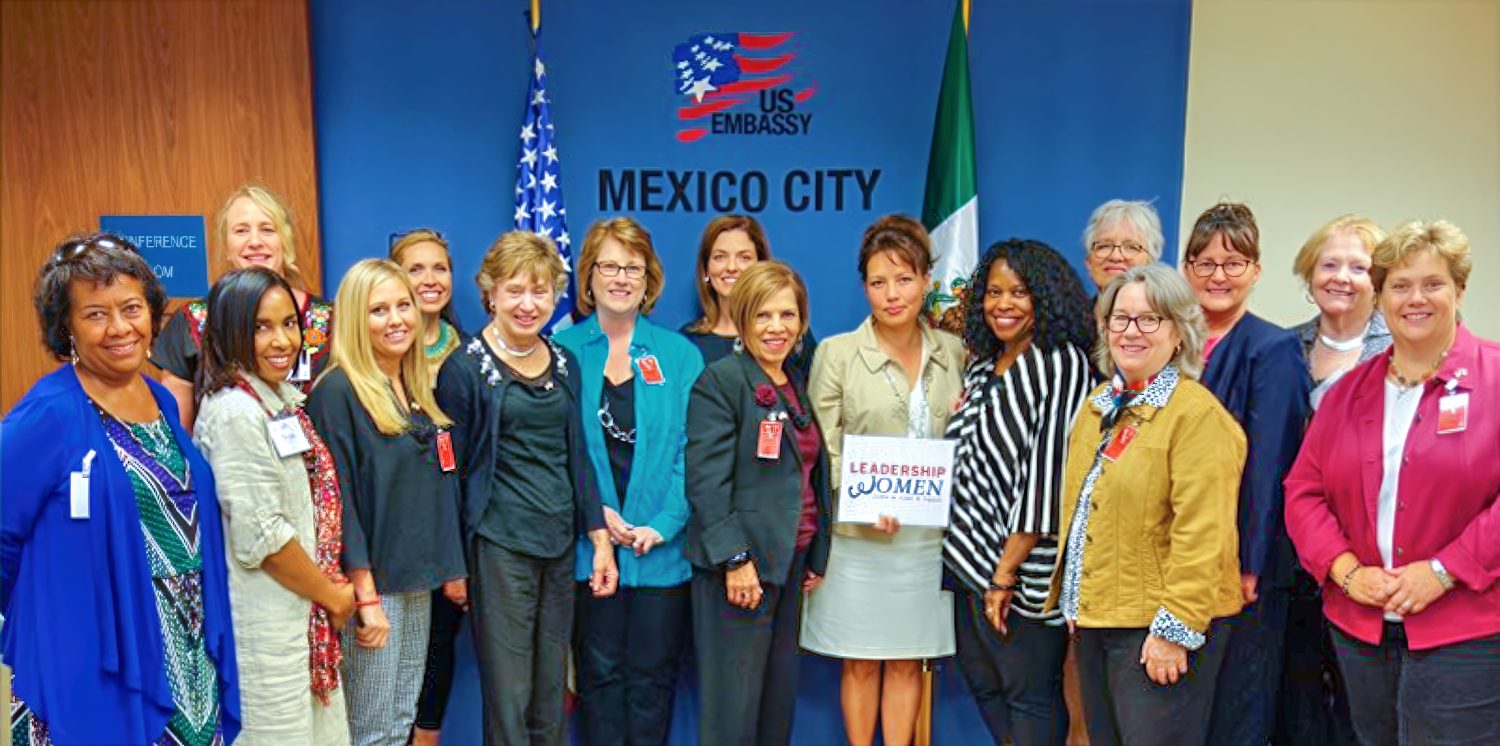
Leadership Women put together this incredible international study trip. Informative lectures, site visits, and leader exchanges across business, government, education, economics, and healthcare were also part of this journey.
You must be logged in to post a comment.