Photo Essay of some of South Carolina’s Revolutionary War burial sites and monuments.
The Revolutionary War is hard to grasp; paintings and even movies try to depict it realistically, but it’s still difficult to picture. When I visit battle sites, I try to visualize the chaos of close battle and feel something of the essence. At the Waxhaws Battlefield, my mind jumped to the aftermath—what it must have looked like for those who came after the battle. The scenes described below are fictional.
Imagining the aftermath of the Waxhaws.
A heavy, suffocating silence prevailed over the Waxhaws. Local farmers gathered with grim expressions to collect the Continental dead, digging a mass grave for 84 shattered bodies. Meanwhile, horse-drawn wagons rattled toward the Meeting House (Waxhaws Presbyterian Church) carrying roughly 150 severely wounded men. The humble log structure became a makeshift hospital, and a house of horrors for those inside.
For Dr. Robert Brownfield, a surgeon’s mate who survived the battle, the scene inside was ear-splitting. Amid the chaos and terror, men and boys—their flesh torn by brutal saber slashes—screamed and groaned. They begged for mercy, called for their mothers, screamed for death. Reeling from the slaughter, Brownfield wondered how he had survived, pushed his racing thoughts aside, and got to work. With few supplies and help from locals, he fought to save lives where violence had obliterated even the slightest mercy.
These harrowing scenes draw on original accounts from Dr. Robert Brownfield, available on the American Battlefield Trust website. The brutality that he and other eyewitnesses described caused widespread calls for fierce resistance to the British occupation of South Carolina.
Over the course of a year, Eddie and I traveled to photograph Revolutionary War landscapes. Part III is a photo essay of gravesites, markers, obelisks, and statues, only a handful of which are scattered across the state. They provide details and help us envision the scenes that shaped our nation. They inspire us, reminding us to recognize and honor the unwavering sacrifices of South Carolinians. If you haven’t already, explore Part I: Battle Sites and Part II: Reenactments of this series.
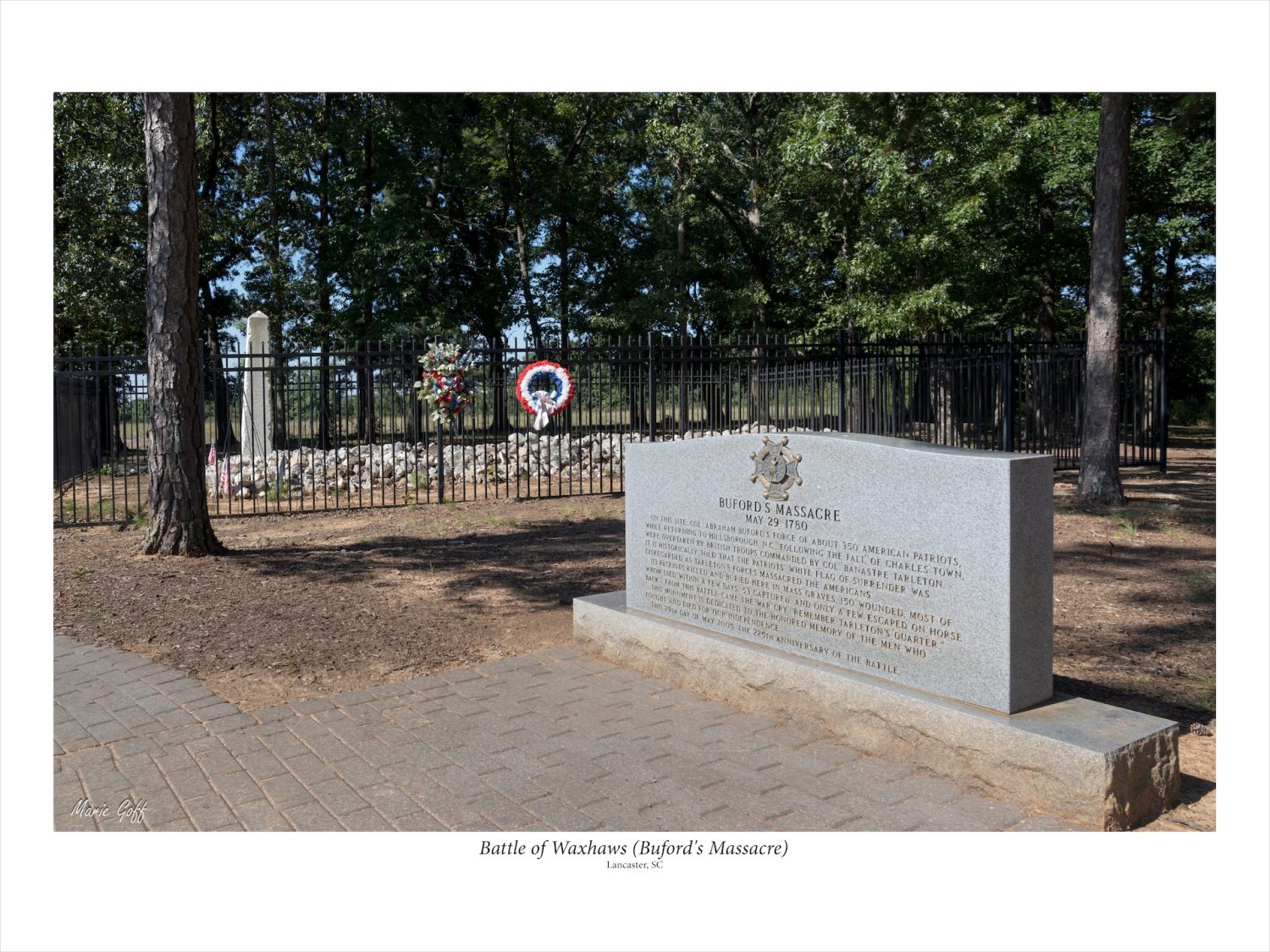
The Waxhaws Burial and Battle Site (Buford’s Massacre), Obelisk and Markers – Dedicated on Jun2, 1860
The 1860 Marble Obelisk: The fifteen-foot marble obelisk was placed at the burial site in 1860 to outline the events. Over time, the inscription was damaged.
The 1955 Replacement Monument: Another marker, placed in 1955, replicates the story.
“Col. Abraham Buford’s 350 Virginians were returning from a failed attempt to relieve Charleston. Lt. Col. Tarleton’s British forces caught them. Nearly all of Buford’s command was killed or wounded, with 84 soldiers laid to rest in the mass grave. The North Face draws attention to the brutality of the aftermath.”
“The cruelty and barbarous Massacre committed on this occasion by Tarleton and his command after the surrender of Col. Buford and his regiment originated the American war cry, ‘Remember Tarleton’s Quarter.’”
Whether it was a battle or a Massacre remains intensely debated, as noted in the Journal of the American Revolution. The site also offers other interpretive information. Find details and the location of the Waxhaws Battle Site on The Liberty Trail.
America 250 Patriots Marker was dedicated on May 25, 2024.
The Andrew Jackson State Park is less than twenty miles from the Waxhaws Battle and Burial Site. The presidential homeplace of the 7th President of the United States of America is important to the story of the Waxhaws Battle Site. Living nearby, Andrew Jackson and his brother Robert accompanied their mother to the site to aid the wounded after the battle. See how these early experiences formed young Andrew’s outlook in the Library of Congress Andrew Jackson Papers
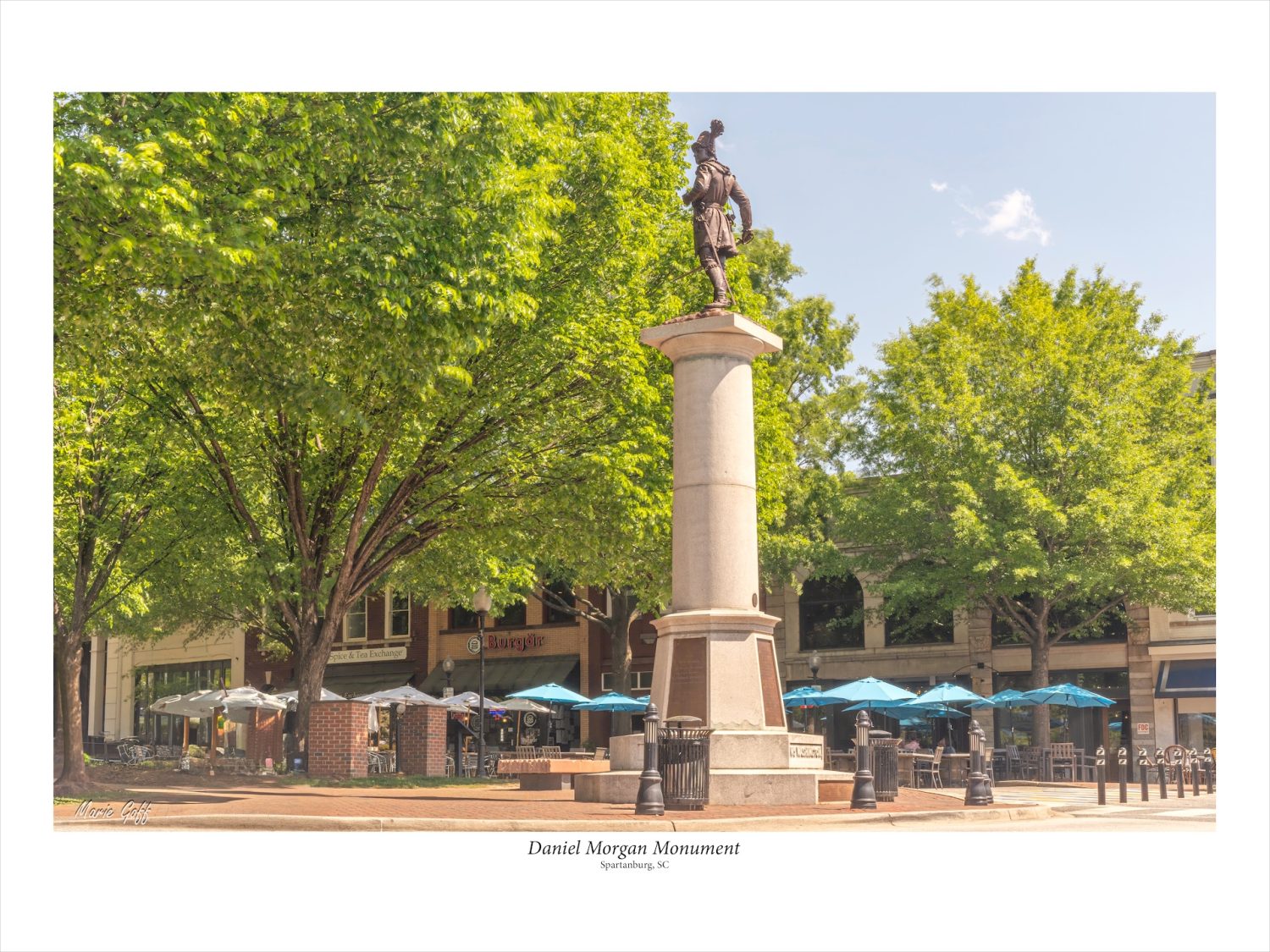
Daniel Morgan Monument – Dedicated on May 11, 1881
From the tragic mass graves of the Waxhaws, we move to Spartanburg, where a downtown monument honors one of the war’s most skilled tacticians: Daniel Morgan. A striking bronze statue captures him forever gazing toward the battlefields at Cowpens, where he cleverly outmaneuvered British commander Banastre Tarleton. For directions, see the Daniel Morgan Monument.
Daniel Morgan’s rise from the poorest circumstances to the highest success makes him one of my favorite characters of the war. Daniel Morgan: A Revolutionary Life, by Albert Louis Zambone, is a good source on Daniel Morgan’s life.
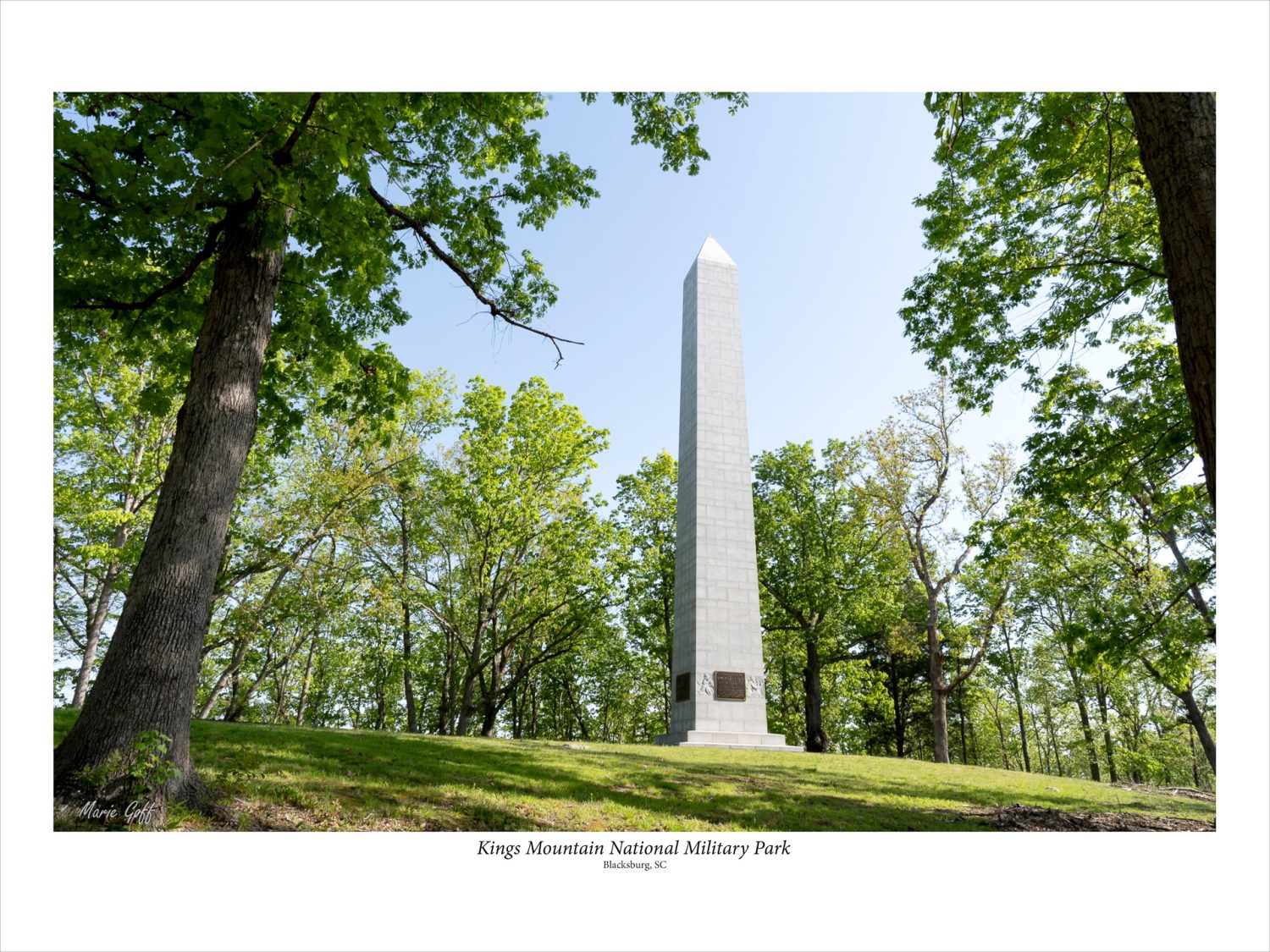
U.S. Monument – Dedicated on October 7, 1909
On October 7, 1780, Patriot militiamen surrounded Kings Mountain and attacked Loyalist troops led by British Major Patrick Ferguson. Fighting their way up the wooded slopes, the Patriots killed Ferguson and forced his remaining men to surrender. The victory lifted Patriot spirits and weakened British efforts to control the South.
An 83-foot-tall obelisk, placed by the U.S. government, honors the 1780 battle.
The National Park Service manages the Kings Mountain National Military Park.
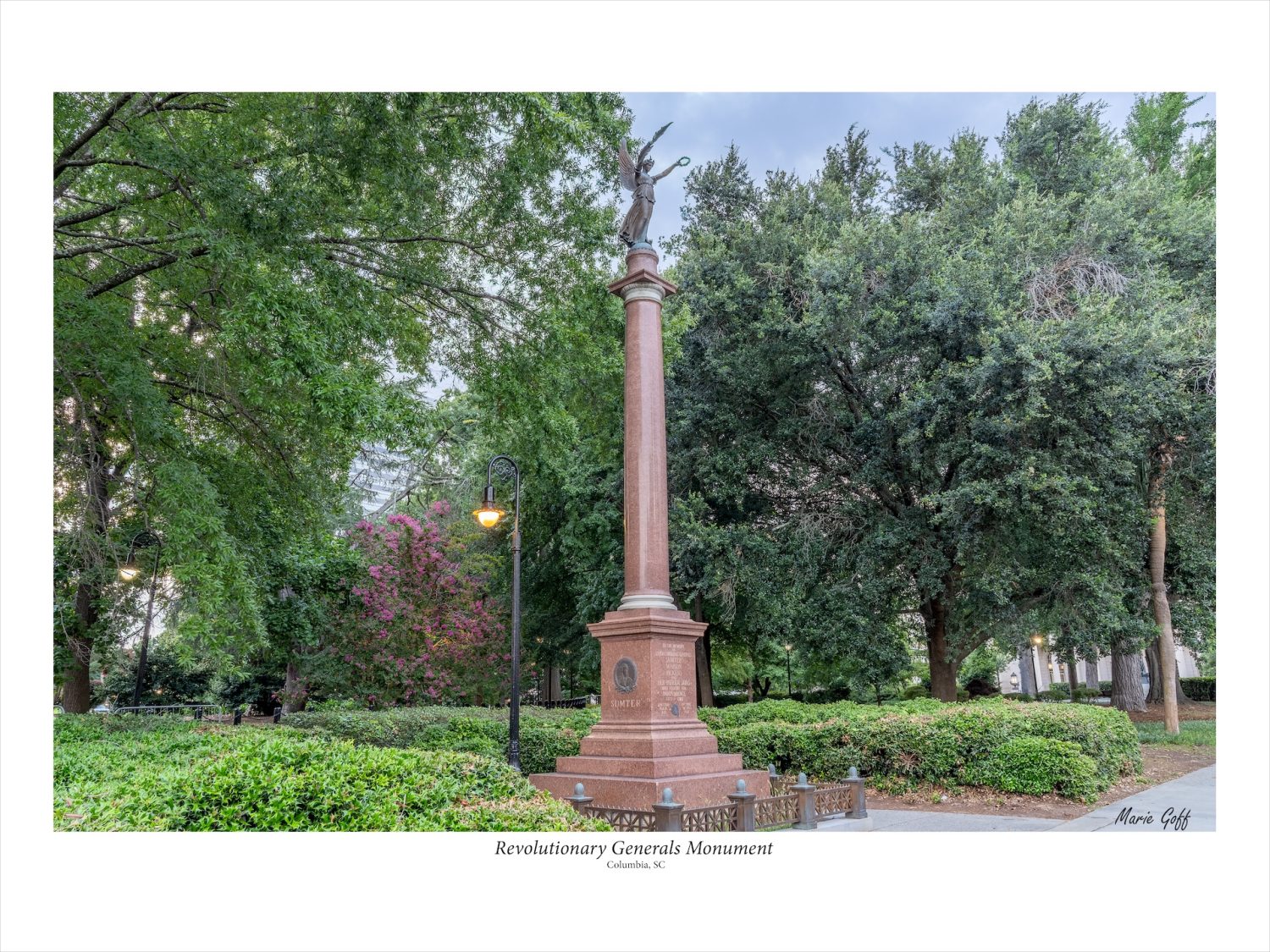
Partisan Generals Monument – Dedicated on November 11, 1913
Leaving Kings Mountain behind, we head to the heart of the state, in Columbia. On the State House grounds, the SC DAR erected a magnificent 27-foot monument honoring three legendary partisan leaders: Francis Marion, Thomas Sumter, and Andrew Pickens.
Capturing this towering memorial took patience and a touch of field improvisation. After trying various ground angles, I finally set up my tripod in the back of my truck. High above the gleaming red granite base, the bronze statue of Nike—the classical Greek and Roman goddess of victory—stands out clearly against the sky.
This monument is one of my favorites because it’s so beautiful. For directions, visit Historic Columbia.
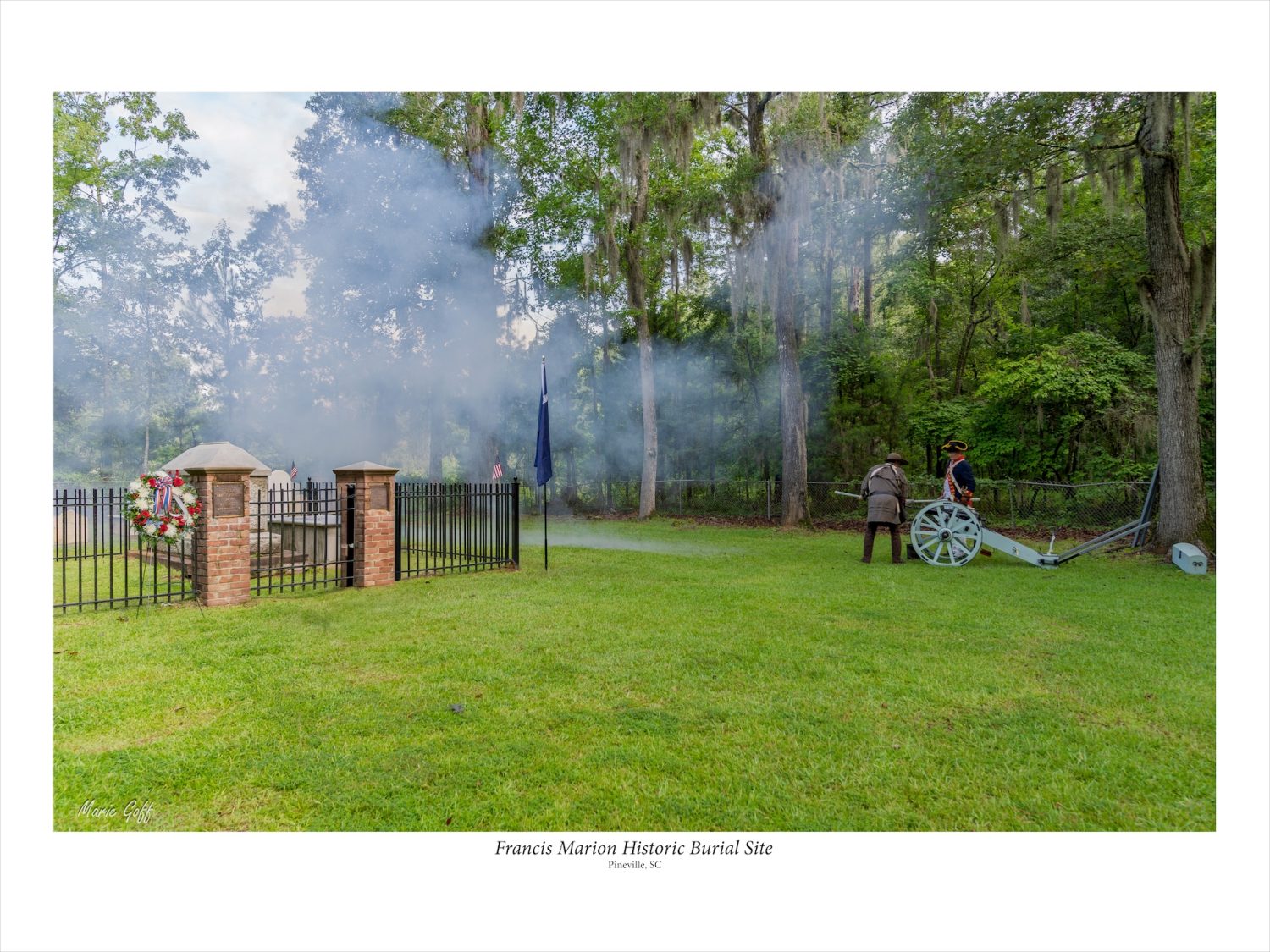
Francis Marion Historic Burial Site – 1975 Re-Dedication (SCPRT)
From Columbia, we continue exploring Revolutionary War burial sites and monuments as we travel deep into Berkeley County. Amid the peaceful grounds of the former Belle Isle Plantation Cemetery, lies General Francis Marion’s final resting place.
A wrought-iron fence surrounds Marion’s tomb, where a historical marker honors his Revolutionary War service. Marion died on February 27, 1795. By 1975, the state had acquired the property and now manages it through the South Carolina Department of Parks, Recreation, and Tourism (SCPRT).
Today, peaceful waters and lofty, moss-draped trees contrast with the fierce guerrilla warfare Marion once waged in these swamps.
I captured this photo of the wreath-laying ceremony, which included live cannon firings by the 5th Company, 4th South Carolina Regiment.
Find details and directions at South Carolina State Parks.
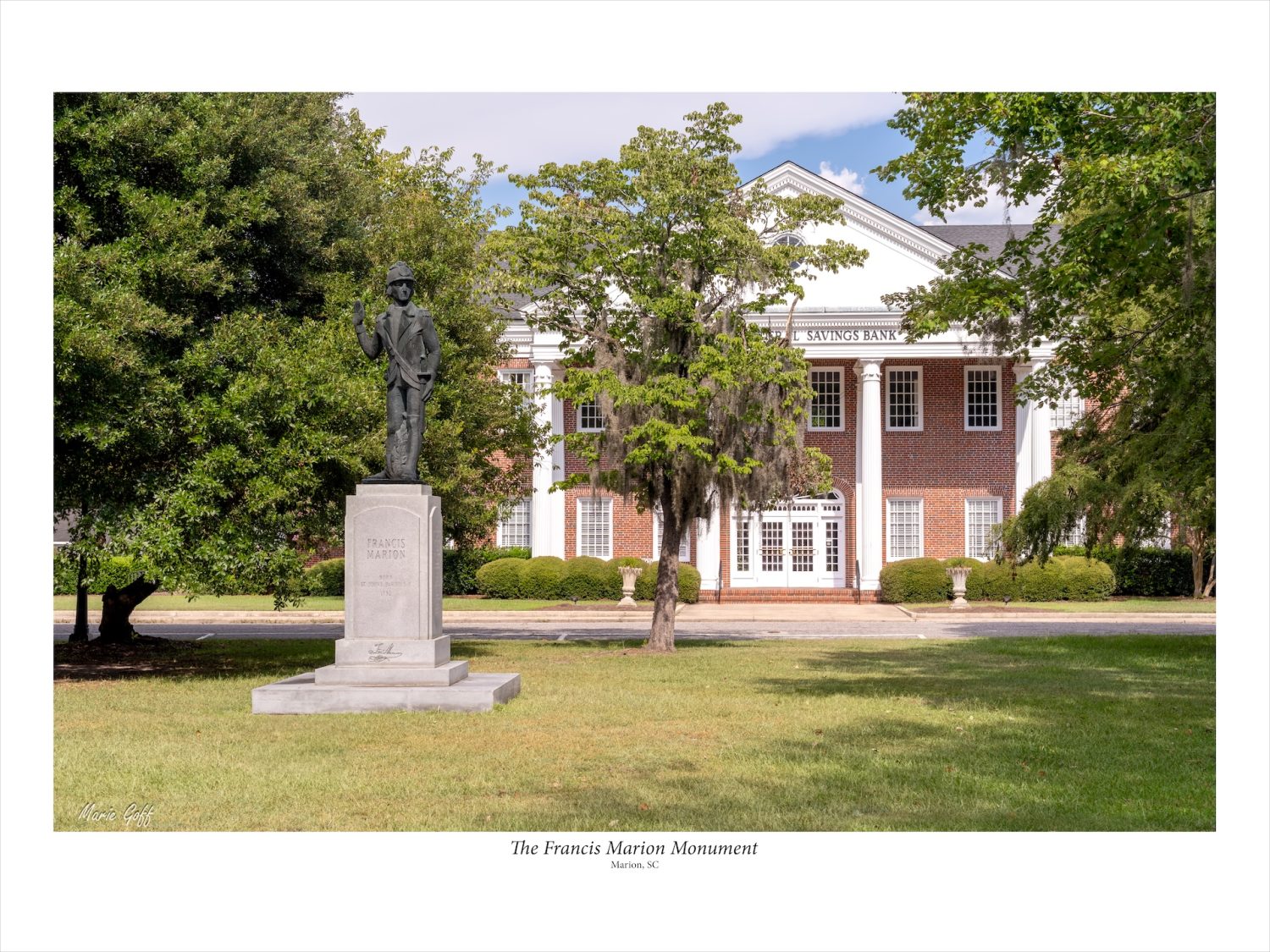
The Francis Marion Statue – Dedicated on April 9, 1976
Leaving the serenity of Marion’s gravesite, our journey heads to the green in front of the Marion County Courthouse, the town named in his honor. Here, a bronze statue of General Francis Marion stands alert and wary, faithfully capturing the spirit of the legendary partisan leader.
Visitors may read Marion’s full biography on the monument, a clever touch. The monument’s four sides display his military titles, key battles, and political offices. His distinctive signature adorns the front of the pedestal.
For details and directions, visit Marion, SC.
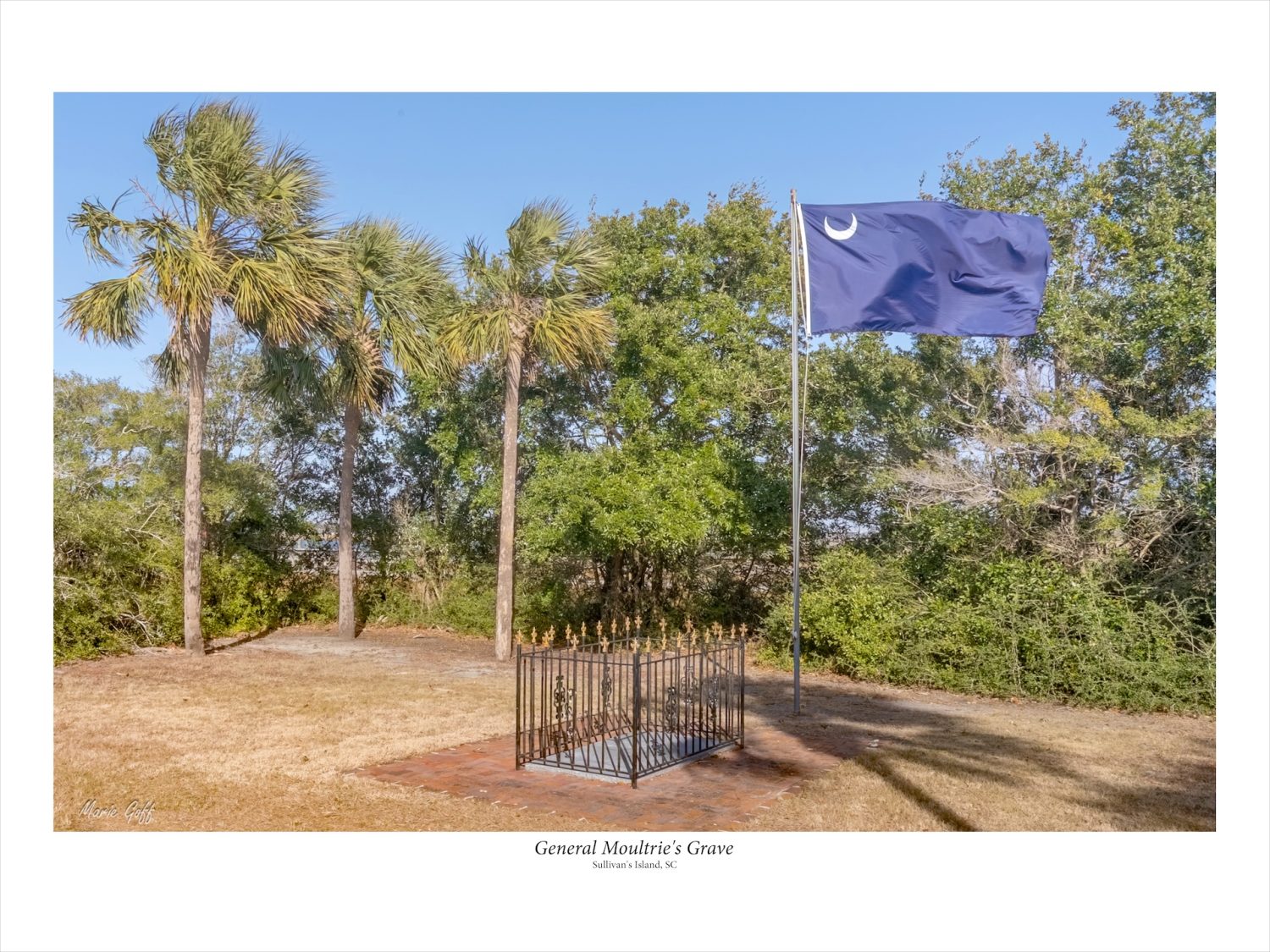
General Moultrie’s Grave – Reinterred on June 28, 1978
One special stop is Fort Moultrie on Sullivan’s Island. On June 28, 1776, General William Moultrie repelled a major British bombardment at the palmetto-log fort on Sullivan’s Island. On July 4, 1776, officials renamed the site Fort Moultrie in his honor.
After Moultrie’s death on September 27, 1805, his family buried him at Windsor Hill Plantation near Charleston. Archaeologists discovered his grave in 1977, and in 1978, officials reinterred his remains at the fort.
An iron fence surrounds his grave, with the distinctive blue-and-white flag flying overhead. To rally his men, Moultrie designed the flag to reflect his troops’ blue uniforms and silver crescents. In 1861, South Carolina adopted Moultrie’s design as its state flag and added the palmetto tree.
Moultrie’s legacy lives on in the symbol that represents South Carolina.
For details and directions, visit the National Park Service.
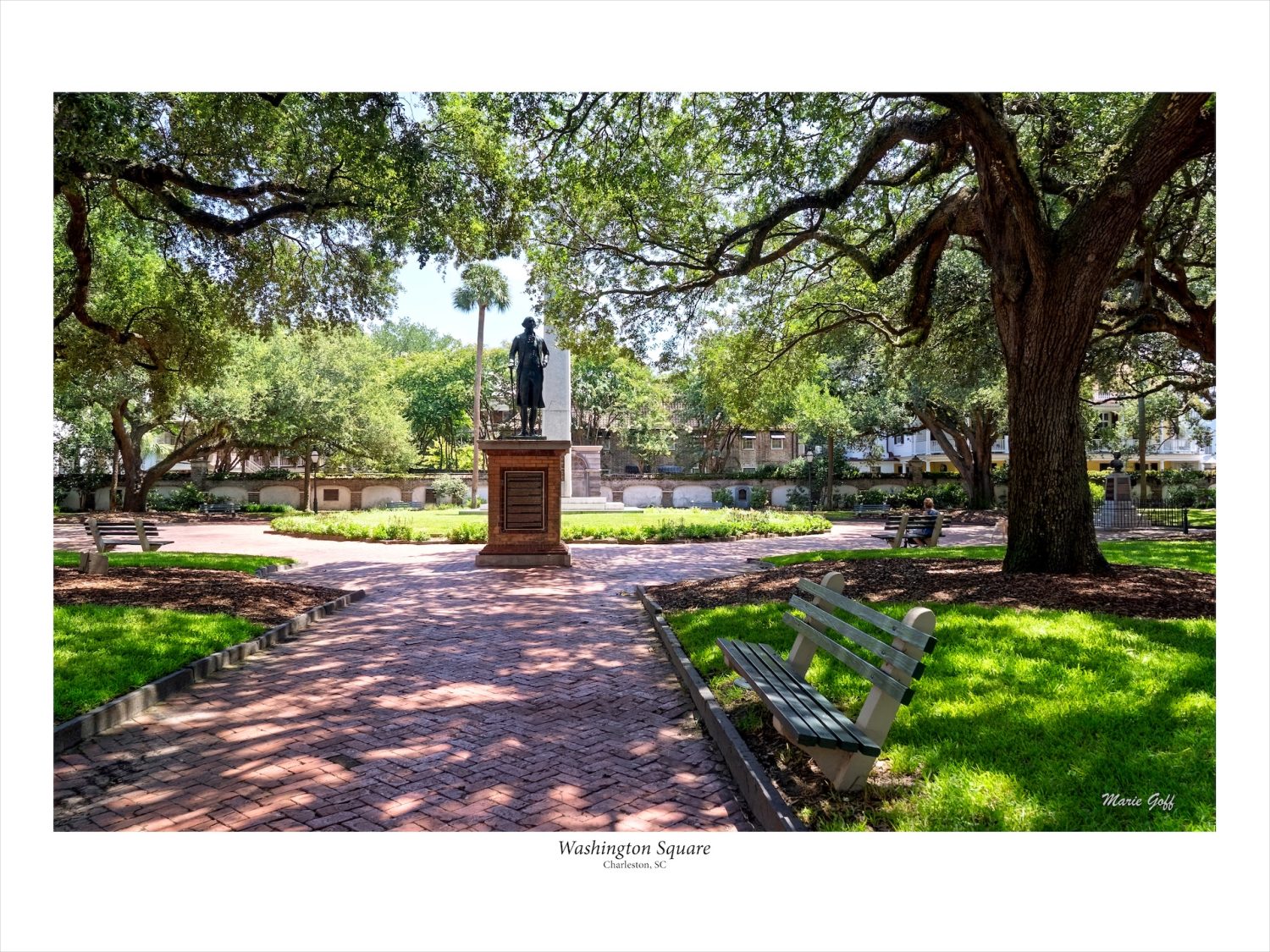
George Washington Statue – Dedicated on December 14, 1999
Next, we stroll through the tranquil gardens of Washington Square in Charleston. Here, a life-size bronze statue depicts George Washington in full military uniform. The historical marker says that Washington’s Light Infantry placed the statue to honor his historic visit to the city. The surrounding square was officially renamed Washington Square. Today, this quiet memorial offers a place to reflect amid downtown Charleston’s historic district.
For details and directions, see the Historical Marker.
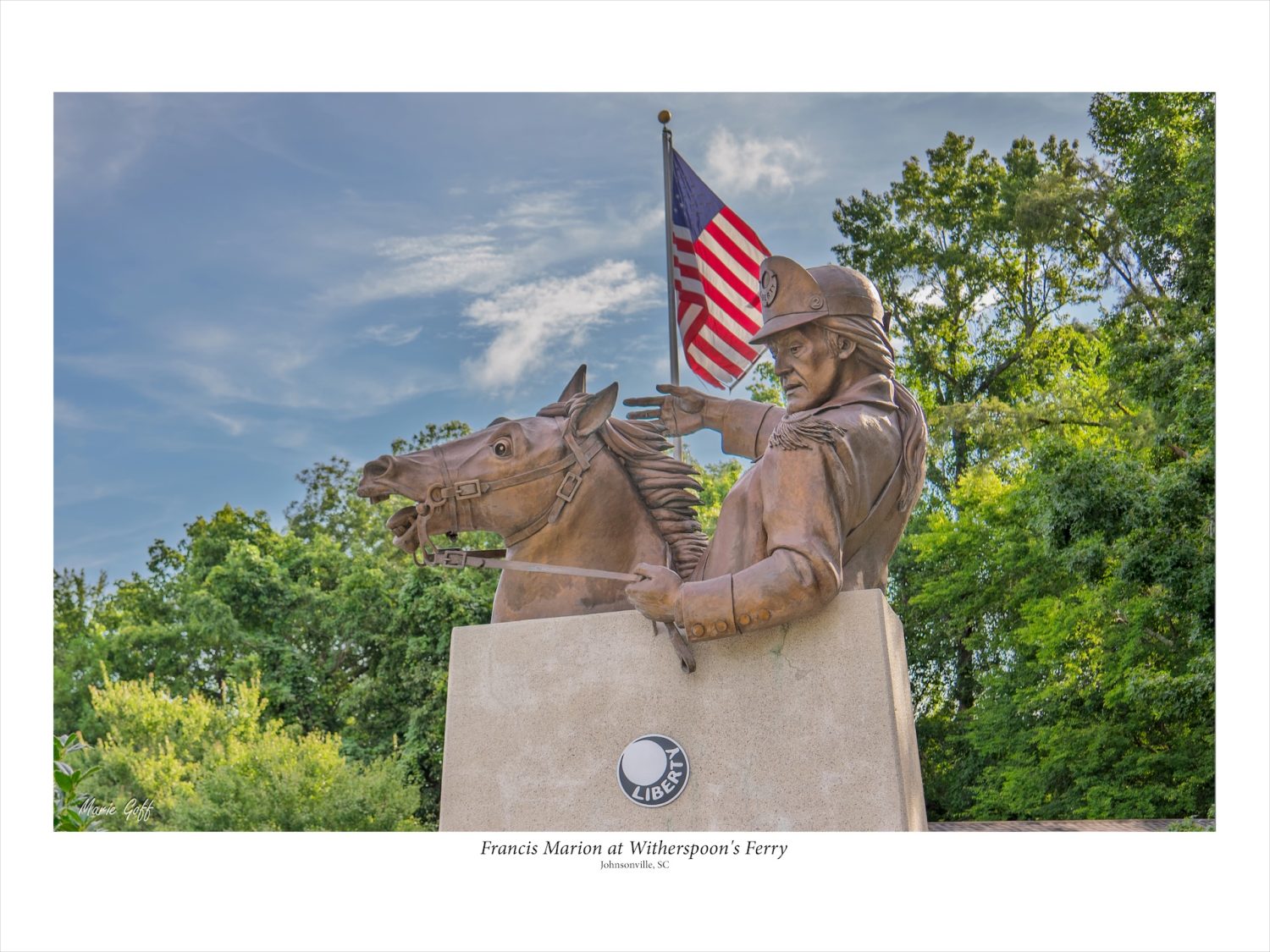
Francis Marion at Witherspoon Landing – Dedicated on May 18, 2013
The trip leads us to Odell Veterans Landing on the Lynches River in Johnsonville. One of my favorites, this monument captures Francis Marion, the Swamp Fox, in his element. Beneath a tempestuous sky, Marion’s calm expression contrasts with his wild-eyed horse. The sculptor captured Marion’s confidence while he navigated familiar swamps, outsmarted the British, and seemed to disappear without a trace.
Standing here, Tarleton’s frustrated words come to mind: “This damned old fox, whom the devil himself could not catch.”
For details and directions, see the Historical Marker.
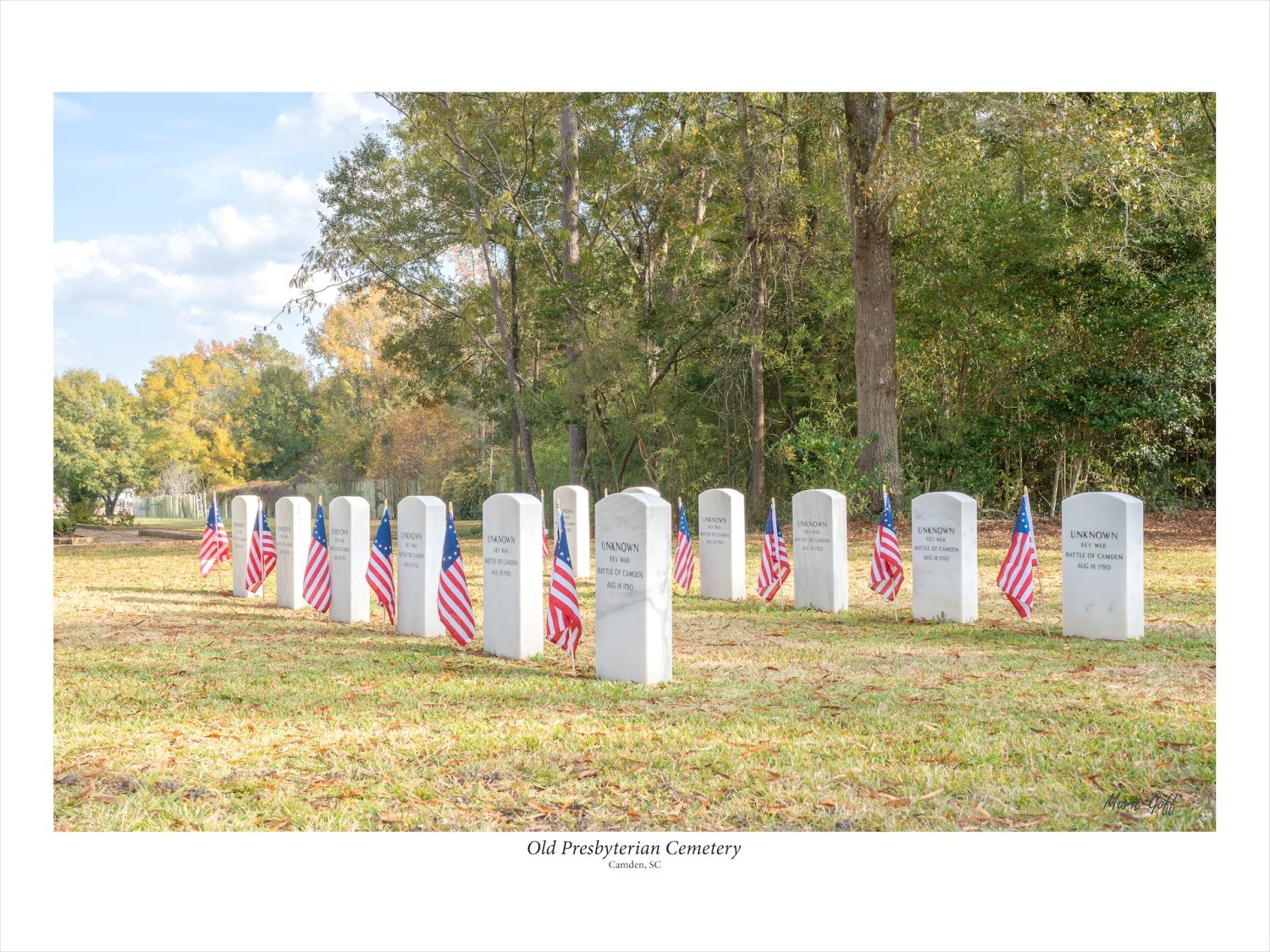
The Old Presbyterian Church Cemetery, Reinterred on April 22, 2023
The essay ends in Camden, where archaeologists unearthed 14 Revolutionary War soldiers on August 16, 2013. They included 12 American Continentals, one Loyalist militiaman, and one British Highlander, according to PR Newswire. On April 22, 2023, they reinterred the 12 Continentals with full military honors. Live oaks and longleaf pines shade neat rows of headstones decorated with small U.S. flags. These peaceful grounds recall the bloody Battle of Camden, fought on August 16, 1780.
Nearby, a towering monument honors Bavarian-born General Johann de Kalb, who died from wounds suffered while leading American troops. Together, these graves and memorials offer a quiet connection to those who sacrificed for American independence.
For details, visit Historic Camden.
Travel Note
This year, as part of ongoing celebrations, the SC250 Commission and local communities are identifying SC’s sites and, in some cases, unveiling new markers; see SC REVWAR markers. Eddie and I often ended up in the same places, and photographed marker dedications and flag-raising ceremonies.
Revolutionary War burial sites and monuments – A Personal Note
Eddie’s direct ancestor, Johann Daniel Little Jr., and three brothers fought in the Battle of Camden. Daniel survived and eventually moved to Kershaw County, South Carolina. He is buried at the Smyrna United Methodist Church. His brother Peter also survived. John Little and Henry Little were killed in action and are honored with others collectively at The Old Presbyterian Church, which bears the heading, “Hundreds of patriots from Delaware, Maryland, North Carolina, and Virginia.”
Family records show that the four brothers left Rowan County, North Carolina, and joined General Horatio Gates to march up the ‘Great Wagon Road’ toward the doomed Camden campaign. The Bishir Scrapbook
Eddie and I zigzagged across the state from one site to the other, often several times. We wanted to capture the pictures in different light to see what worked best. We also took as many pictures as we could during the seasons when the battles occurred. This year, the South Carolina State Library exhibited these photos and others from the series.
You must be logged in to post a comment.